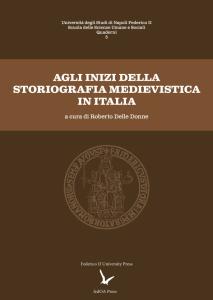
The Beginnings of Medieval Historical Scholarship in Italy
Keywords:
medieval historiography, Italian medieval studies, history of historiography, history of disciplines, nineteenth and twentieth centuries, historical scholarshipSynopsis

Publisher: FedOA - Federico II University Press
Series: School of Humanities and Social Sciences. Working Papers
Pages:
Language: Italian
Abstract: Between the nineteenth and twentieth centuries, medieval history emerged in Italy as an autonomous field of study through a process that was anything but linear. It developed in constant dialogue with legal history, literary history, art history and economic history, as well as with archaeology, palaeography and diplomatics; it fashioned its own research tools, institutional settings and interpretative traditions; and it produced representations of the Middle Ages that were also to exert a profound influence on historical understandings of the nation. The essays collected in this volume reconstruct some of the decisive stages in this process. On the one hand, they examine disciplinary boundaries and intersections, antiquarian and philological practices, the editing of sources, major publishing enterprises, textbooks and research institutions. On the other, they explore the formation of some of the central questions around which Italian medieval studies came to be organised: the relationship between North and South, the Lombard question, communes and lordships, forms of political participation, and relations between the Church, the papacy and secular powers. A comparative examination of the study and reception of the Italian Middle Ages in Germany, France, Britain, Spain, Russia and Hungary further places this development within a broader European circulation of historiographical models, categories and scholarly practices. What emerges is the history of a discipline understood not simply as a succession of individual scholars and works, but as the collective construction of concepts, methods, sources, institutions and scholarly communities. From this perspective, the origins of Italian medieval studies also provide an opportunity to reconsider some of the categories through which the Middle Ages continue to be conceptualised and studied today.
Chapters
-
Medieval History and the Literary History of the Middle Ages
-
Legal Historiography and Medieval History: Convergences and Divergences
-
Studies of the Medieval Economy (from Italian Unification to the Aftermath of the First World War): Preliminary Considerations
-
The Beginnings of Medieval Historical Scholarship in Italy: The Science of Documents in the Last Quarter of the Nineteenth Century
-
Medieval Archaeology
-
The Historiographical Genesis of a New Kunstlandschaft: Medieval Art in Southern Italy
-
The Re-edition of the Rerum Italicarum Scriptores, “a Duty of the New Italy”: Preliminary Research in Vittorio Fiorini’s Correspondence
-
Editions of Medieval Sources and Photographic Reproductions between the Nineteenth and Twentieth Centuries: the “Fonti della Storia d’Italia” and the New “Rerum Italicarum Scriptores” in the Historical Archive of the Istituto Storico Italiano per il Medioevo
-
Erudition in Publishing between Dream and Reality: Scipione Lapi and His “Colossal Enterprise” (1893–1923)
-
Secondary-School Textbooks: The Middle Ages in the Construction of the Image of the Nation
-
University Textbooks: Cesare Paoli’s Palaeography and Diplomatics
-
The Middle Ages in Publishing: The Zanichelli Case
-
The “Two Italies” in Medieval Studies between the Nineteenth and Twentieth Centuries
-
The Lombard Question
-
The Commune and Democracy in Historiography between the Nineteenth and Twentieth Centuries
-
Institutions and Initiatives for the Edition of Medieval Sources in Post-Unification Turin
-
The Regia Deputazione di Storia Patria and the Società storica subalpina: A Comparison of Two Cultural Institutions (1880–1935)
-
The Discovery of Ligurian Notaries in Medieval Studies between the Nineteenth and Twentieth Centuries
-
Carlo Merkel in Pavia in His Writings and Letters to Cipolla (1893–1899)
-
Regional Sources and the National Theme: The Genesis of the Codex diplomaticus Langobardiae
-
“A Silent and Industrious Work”: The Deputazione di storia patria per le Venezie and Its Editorial Projects (1873–1900)
-
“The Strange Vicissitudes of My Life, Partly Military, Partly Literary”: Giuseppe De Blasiis and His Correspondents
-
Sicilian Medieval Studies in the Nineteenth Century: Research Trajectories
-
Michele Amari’s Encounter with Jules Michelet: Historiography and Myths of the Sicilian Vespers between France and Italy
-
The Italian Middle Ages and the Professionalisation of Historical Studies in Britain (1857–1923): Between Universal History and Political Science
-
Spanish Medieval Studies and Their Connection with Italian Historiography: The Consolidation of Professionalisation in the Twentieth Century
-
Russian Historiography and the Italian Middle Ages (1850–1922)
-
Angevin Naples and Its Relations with the Kingdom of Hungary in Hungarian Historiography between the Late Nineteenth and Early Twentieth Centuries
Downloads
References